
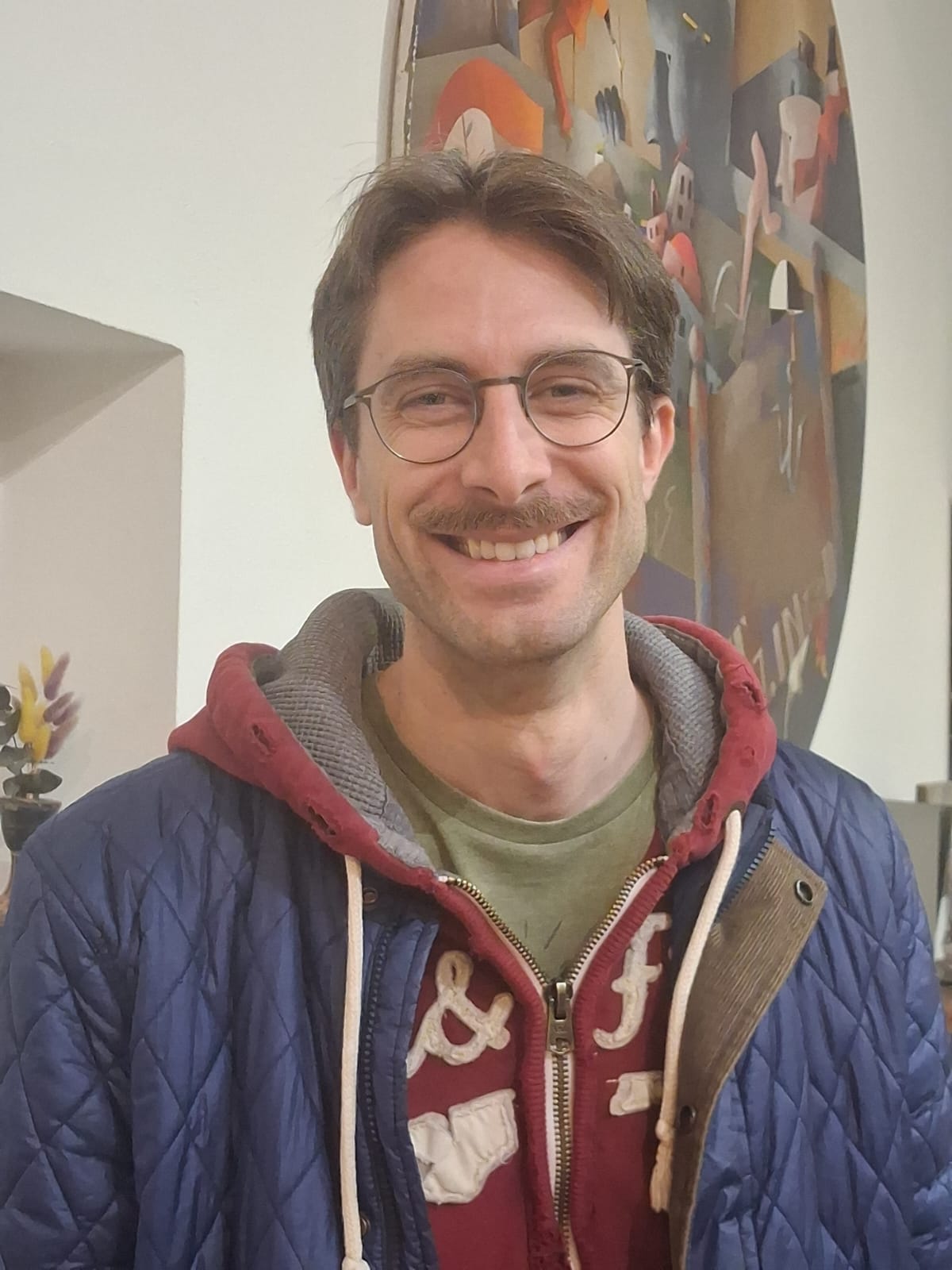
Federico Girotti has been a researcher in Probability at the Department of Mathematics of the Polytechnic University of Milan since 2023.
Federico, what fascinates you about mathematics?
From the very beginning, I was captivated by the precision and clarity of mathematical language: every term and expression has an exact, unambiguous meaning, and this prevents one from getting lost in inconclusive discussions. However, the importance of mathematical language does not end here: giving precise form to an idea or concept in order to use it is essentially equivalent to finding its proper definition. It is true: mathematical formalism can be discouraging at first, but the effort is absolutely rewarded!
Another aspect that fascinated me is how mathematics reveals hidden structures and surprising facets of problems: often their solution becomes within reach when they are viewed from the right angle, with an innovative perspective.
What does your research focus on?
My research activity lies within quantum probability, which is the mathematical theory arising from the computation of probabilities in systems governed by the laws of quantum mechanics. The description of such systems is inherently probabilistic: regardless of the state in which we prepare a quantum system, there is always a measurable quantity whose value cannot be predicted with certainty. However, “classical” probability theory is not able to explain many phenomena of quantum mechanics, such as the fact that the laws of observations depend on the order in which measurements are performed; for this reason, a more general theory is needed.
More specifically, I study models that describe the interaction of a quantum system with its surrounding environment; what interests me is analyzing the reduced dynamics of the system over long times, the estimation of unknown parameters, and the study of stochastic processes emerging when the environment is measured. The fascinating aspect of these problems is that they can often only be solved by combining ideas and techniques from different areas of mathematics, such as classical probability, operator theory, linear algebra, and functional analysis.
What has your educational and professional path been?
I studied Mathematics at the University of Milan. During my fifth year, the Erasmus program allowed me to spend a semester in Amsterdam; the period abroad represented a fundamental opportunity for growth, giving me the chance to experience a different way of living and a different academic environment. The time spent in the Netherlands allowed me to carry out my final thesis project on a problem in statistical inference under the supervision of a researcher from the CWI in Amsterdam.
At the end of my university studies, I felt the desire to deepen some topics that had fascinated me (especially some elements of operator theory and the study of Markov chains), so I decided to apply for a PhD program. I discovered that quantum probability brought together the topics that had interested me, and that in Pavia there was the opportunity to conduct research on these themes; so, I applied there and was accepted. There was already an excellent research group working on these topics at Polytechnic as well, but I admit I preferred Pavia because, after a lifetime studying in Milan, I wanted to experience another Italian academic environment; I am aware I did not move too far, but it was still a beginning!
After completing my PhD, I obtained a postdoctoral position at the University of Nottingham (now that was quite a change!), where I worked for two years; I consider this additional experience abroad to be very valuable, but in the long term I had planned to return to Italy. When the opportunity arose to join the Polytechnic, I seized it immediately, and this is where I still work today.
What advice would you give to students?
My advice is not to passively go through university, but to make the most of it, to explore one or more fields of knowledge, to discover what one is passionate about and what one is suited for. It is the best time to experiment without being afraid of making mistakes or failing: university offers an environment in which one can make mistakes without “getting hurt” and where one can fully and without too much fear exploit the pedagogical power of error. The goal is not to simply obtain a degree, but to better understand ourselves, our inclinations and interests, to develop strong reasoning skills, and to build a solid knowledge in a specific field.
What do you teach?
So far I have taught Probability and Mathematical Statistics to first-year Management Engineering students; I really enjoy teaching this course because it shows how randomness can be tamed through mathematics, presents some profound results—including the law of large numbers, which bridges mathematical abstraction and reality—and, finally, it demonstrates some practical applications to simple problems of statistical inference.
What are your interests outside of work?
I really enjoy going to the theater or the cinema, reading (mainly novels), and, although I am not particularly sporty, skiing or hiking in the mountains.