
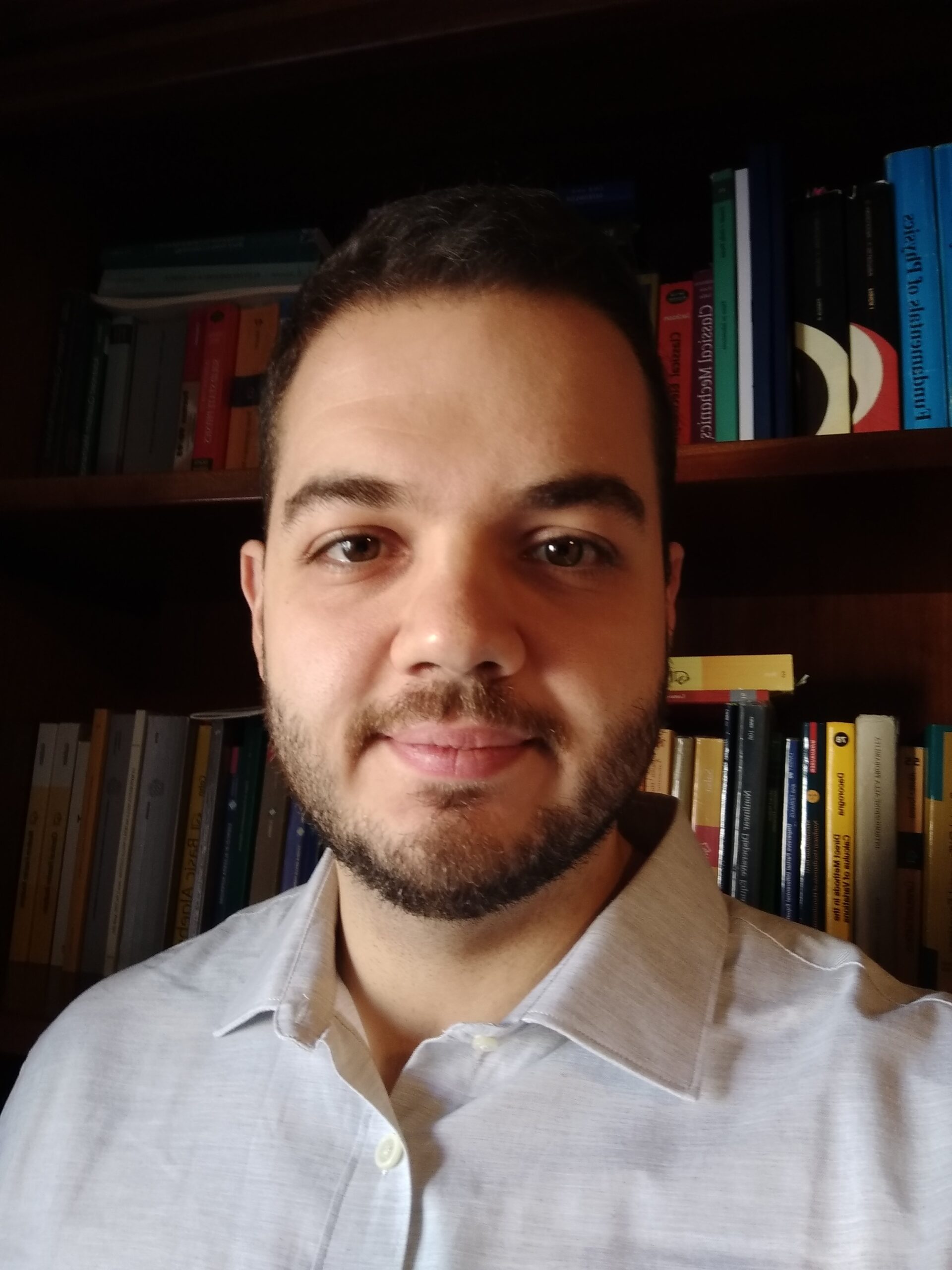
William Borrelli works at the Department of Mathematics of the Politecnico di Milano since 2022, first as a fixed-term researcher and now as an associate professor of mathematical analysis. We asked him to tell us something about his work, his interests, and his path.
What were the main steps in your journey before arriving in Milan?
I graduated in Mathematics at the University Federico II of Naples. During my master’s degree, I spent several months at Université Paris Dauphine, where I began working on my thesis, before returning there for my PhD. Later, I came back to Italy as a postdoc at the De Giorgi Center of the Scuola Normale Superiore in Pisa. Subsequently, I was a researcher at the Università Cattolica and then at the Politecnico di Milano, where I have recently become an associate professor of mathematical analysis.
The PhD experience certainly had a great impact on my training, shaping my approach to research in a decisive way from several perspectives. The postdoc in Pisa was another fundamental step in my path. Especially in the early stages of my career, a crucial aspect was the continuous exchange with colleagues at my same career stage, as well as with senior researchers. Fortunately, I can say that interaction with many people, in various forms and occasions, has continued over time and is still very active, both within the department and with colleagues working elsewhere.
What do you mainly work on in your research?
My research activity is in the field of mathematical analysis, often in connection with problems and topics arising from physical modeling. I am particularly referring to quantum mechanics and solid-state physics. For this reason, my work often intersects with mathematical physics. Since my PhD, I have worked on Dirac equations, which appear in various physical and geometric contexts, and more recently I have been working on spectral theory, in collaboration with the Mathematical Physics group of the Department.
You are currently the principal investigator of the local unit of the PRIN 2022 project “Nonlinear dispersive equations in presence of singularities”. Can you tell us something about the idea and objectives of the project?
The project involves, in addition to the unit at the Politecnico di Milano, another unit at the Politecnico di Torino and one at the University Federico II of Naples. The goal is to study various features of linear and nonlinear dispersive equations arising from different areas of physics, such as nonlinear optics or solid-state physics, and their rigorous justification as effective models for the physical systems considered. In particular, we will focus on Schrödinger- and Dirac-type equations with a singular structure, in a broad sense. In some cases, the effective description of certain physical systems leads to the study of singularities of various kinds. For example, specific mechanisms may confine the system to a region with a branched shape or singular geometry. Alternatively, one may consider reference models where interactions are “concentrated” at a point or on geometric objects of lower dimension than the ambient space. This leads to dispersive equations with singular coefficients or settings, for which it is interesting to study the well-posedness of the associated evolution problem, the existence of stationary solutions, and spectral properties.
Can you tell us about a result from one of your recent works?
It is a classification result for minimum-energy solutions of Dirac equations with critical nonlinearity in Euclidean space, which arise both in geometric questions and in the description of certain systems in solid-state physics and nonlinear optics. I worked on this problem during my postdoc in Pisa, together with two colleagues from the Scuola Normale.
The equation in question is elliptic but of first order. This makes many known techniques for second-order equations inapplicable. Moreover, the unknown is not a scalar function, but takes values in complex vectors (technically, a “spinor”). In the literature, some examples were known, characterized by specific geometric properties (constructed from so-called “Killing spinors”), but it was not clear whether others existed. We realized that classical “direct” analytical approaches would not work, so we found a proof based on purely geometric ideas, achieving the desired result.
Let’s briefly go back to the beginning of your path. When did you decide to study mathematics? And when did you start thinking about turning your interest in mathematics into a career?
Since childhood, I have had a strong interest in mathematics, and later also in physics. Therefore, I was always sure that I wanted to continue studying it and somehow make it my profession. As I progressed, I reflected on which path to take for my university studies and whether to study mathematics or a related discipline, but in the end I had no doubts.
What do you like most about your job?
I really appreciate the fact that there are both moments of interaction of different kinds—with students, as a teacher, and with colleagues, for example during scientific collaborations. At the same time, there are also phases of individual work, such as when preparing a lecture, working on a paper, or consulting the literature.
Outside of mathematics, what are your hobbies and passions?
I really enjoy listening to music, across very different genres, taking long walks, and traveling. I am not particularly methodical or organized when it comes to hobbies, probably because mathematics already takes up a large part of my passions!