
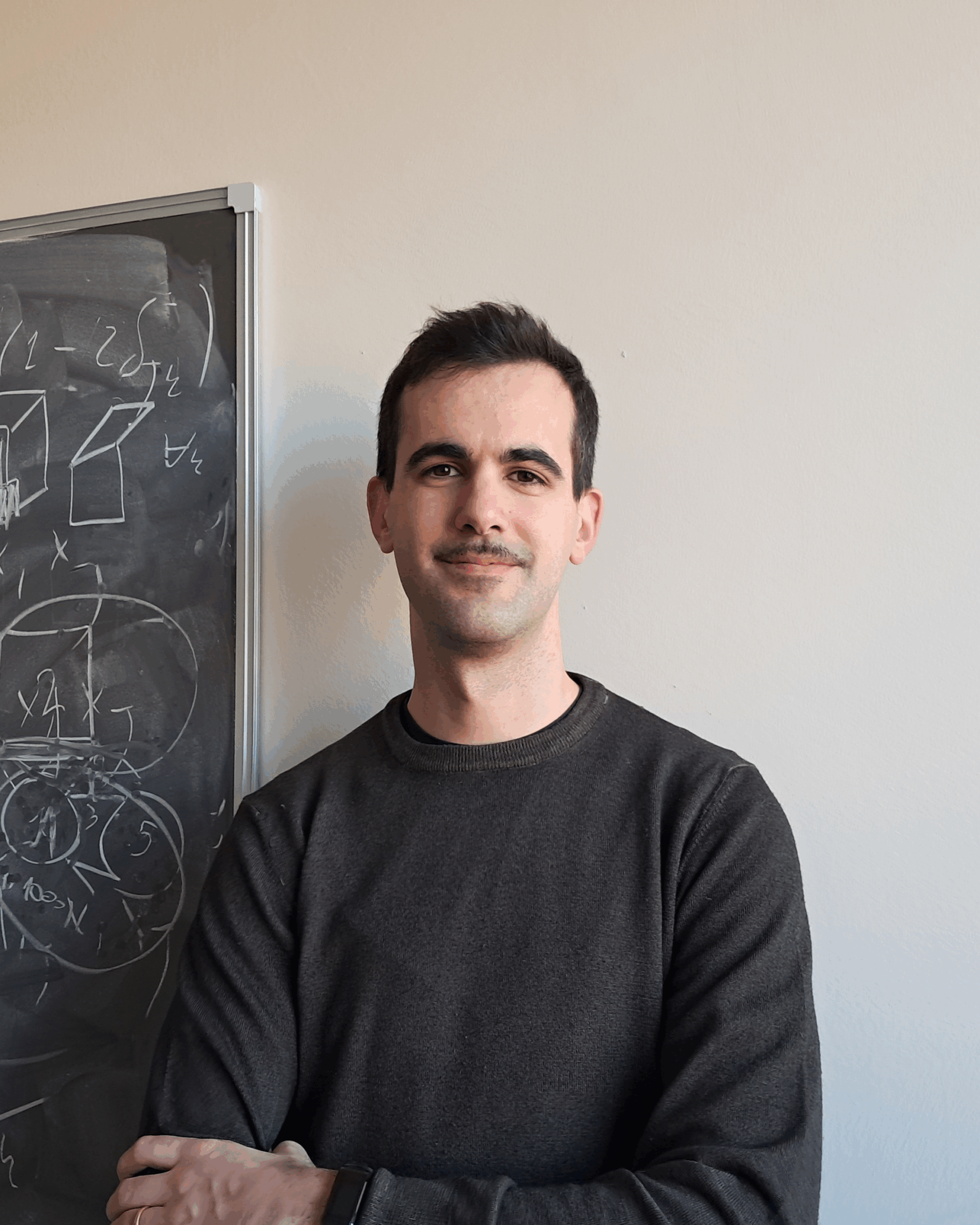
Francesco Regazzoni is a tenure-track researcher at the Department of Mathematics and a member of the MOX laboratory (Modeling and Scientific Computing). We spoke with him about his path, his research, and his passions.
Francesco, what do you work on in your research?
I work in applied mathematics and, in particular, I develop models and numerical methods to describe complex phenomena. The main application area of my research is the simulation of the human heart: I aim to understand and simulate its functioning in order to support research in cardiology and, in the long term, improve personalized medicine. I am also interested in the interaction between machine learning, artificial intelligence, and physical models, a field known as Scientific Machine Learning.
Why is it useful to model the heart with mathematics?
The heart is an extraordinary machine, but its complexity makes it difficult to study using only experiments and observations. Mathematical models make it possible to simulate its behavior in a controlled way and to test hypotheses that would be difficult to verify in the laboratory or in clinical settings. This is essential both for better understanding its physiology and for developing tools that help doctors make more informed decisions about patients.
Mathematical models can in fact be personalized using data such as images or clinical measurements from a specific patient, thus creating a digital twin of the patient’s heart. The goal of our work is that, in the future, doctors will be able to use these virtual hearts to test intervention strategies in advance and tailor the most suitable treatment for each patient.
Turning to Machine Learning and Artificial Intelligence, how do they connect to your research?
The numerical simulation of complex models is often very costly in terms of time and computational resources. This is currently the main obstacle to their widespread use in many fields, including the biomedical one. Machine Learning can be used to build approximate versions of physics-based numerical models, trained on a collection of precomputed simulations, which—albeit with some approximation—can provide answers with times and costs compatible with real-world applications. The challenge is to find the right balance between accuracy and computational cost, thereby also reducing environmental impact. In addition, Machine Learning can help integrate experimental data with mathematical modeling, improving the predictive power of the models.
You recently received a grant of over €1.2 million from the prestigious Italian Science Fund (Fondo Italiano per la Scienza), in the Starting Grant line for emerging researchers, with a project titled “SYNERGIZE: Synergizing Numerical Methods and Machine Learning for a new generation of computational models”. Can you tell us something about the goals of this research?
Machine Learning is becoming increasingly pervasive in all our lives and— as we mentioned earlier—also in the field of numerical simulations. However, crucial challenges remain open, including how to ensure that predictions obtained with Machine Learning models respect the laws of physics and guarantee certified accuracy, which is essential in application areas where errors can carry high costs (financial or social). Personally, I believe the key is not to replace traditional models with Machine Learning, but rather to think of new approaches where data and physics work together in synergy.
Tell us a bit about your path. What led you to enroll in Mathematical Engineering after a classical high school education?
When I discovered the existence of the Mathematical Engineering degree program, I did not fully understand what it was about, but from the name it seemed right for me: I had always had a passion for mathematics, and the idea of applying it to solve real-world challenges fascinated me. So, without overthinking it, I enrolled.
What did you like about mathematics?
For me, mathematics was first and foremost something enjoyable, which I approached through initiatives such as math games and olympiads. I believe these are excellent opportunities to show young people how fun and stimulating mathematics can be. The face of mathematics that emerges in these contexts is closer to that of research than to what is typically seen in school, where one mainly learns to perform calculations and apply rules mechanically. In these mathematical games, instead, a problem is presented without specifying which technique should be used to solve it. This stimulates creativity and gives an idea of what doing research in mathematics really means.
And then, did your relationship with mathematics change?
During my university studies, I discovered the beauty and elegance of mathematics and its theories, as well as the boldness of the constructions developed by mathematicians. I therefore included as many mathematics courses as possible in my study plan. Later, I realized that applying the same approach to real-world problems—even in areas that tend to resist the rigor and coherence of mathematics—was even more fascinating to me. Thanks to my PhD advisor Alfio Quarteroni, I had the opportunity to start working on the application of mathematics to the study of the human heart.
What advice would you give to young people pursuing a STEM path?
My personal advice is to use the university years to build a broad background, exploring widely and without fear of following your curiosity. I often see students who think that, in order to enter the job market, they must already be specialized in a specific field before graduating and acquire skills that make them immediately productive for a company. However, there will be time for that later: university years should mainly be seen as an opportunity to build your “toolbox” and to explore different areas, so as to discover what you truly enjoy.
What do you like most about your job?
That you never get bored, and that every day is different from the previous one. In addition to research, which by its nature constantly brings new challenges, being a researcher also means dedicating part of your time to teaching. Teaching the new generations of engineers at the Politecnico is a stimulating activity that also enriches the teacher: questions from students encountering a concept for the first time often bring surprisingly fresh perspectives.
A researcher’s life also includes writing papers and research proposals, supervising younger researchers, and interacting with colleagues both within the same field and across different disciplines. Each of these activities is both a challenge and an opportunity for growth.