How did you end up at the Politecnico?
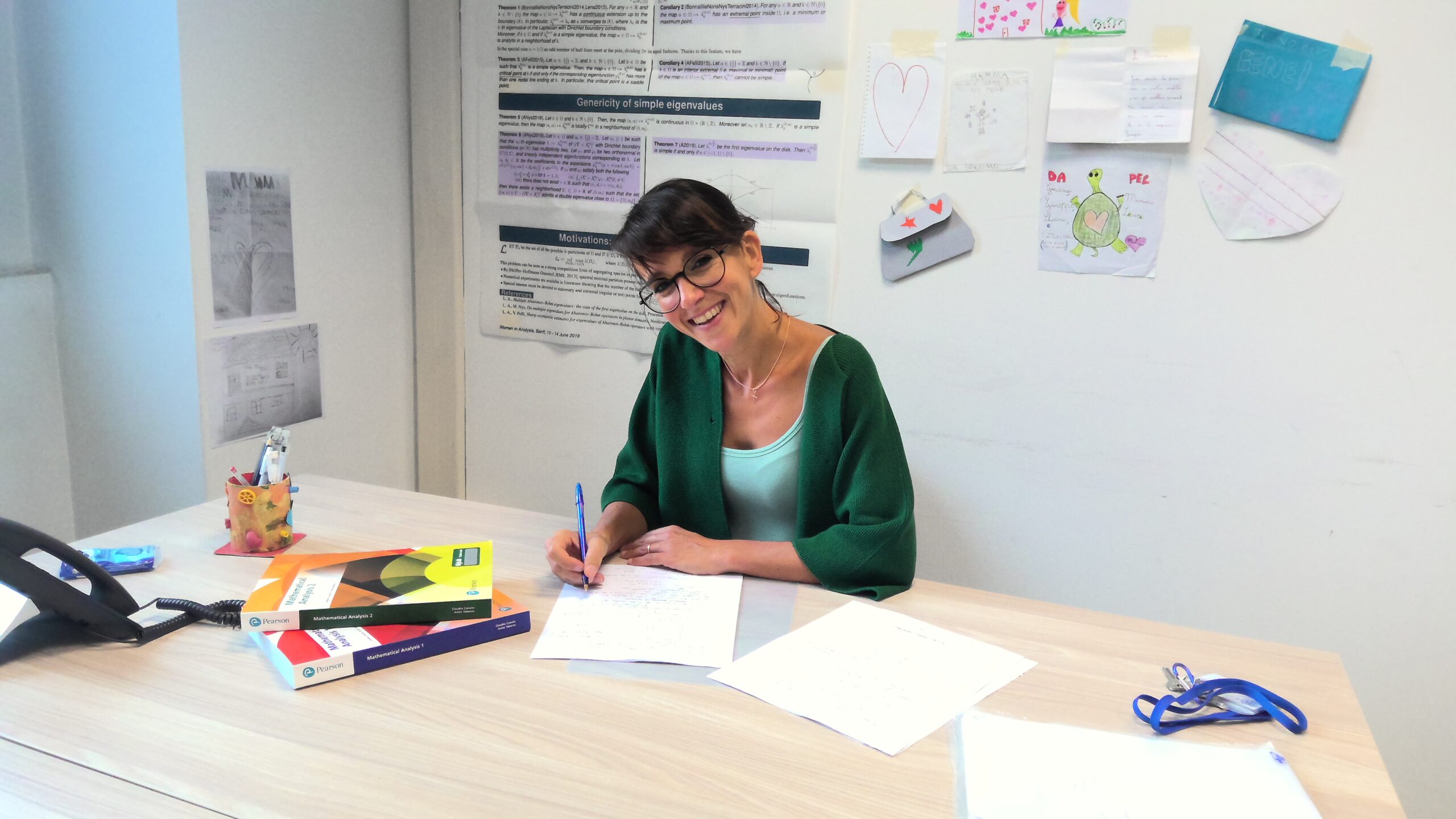
I have been an associate professor of Mathematical Analysis at the Department of Mathematics of the Politecnico di Milano since March 1, 2024.
My path toward research began with my master’s thesis at the University of Milan in 2007. During my master’s studies, I became passionate about topics in nonlinear analysis, particularly the Calculus of Variations. I cannot say exactly why those topics rather than others… it was a kind of preference not determined in advance, like many we experience in life: you are struck by one person and not another, one landscape and not another, one kind word and not another… The professors I met during my university years were also decisive! I remember two or three in particular with gratitude for their passionate, precise, and engaging lectures.
In nonlinear analysis, I saw many mathematical aspects encountered in previous years come together with the aim of studying the existence or properties of solutions to partial differential equations, which in turn often arise from physical models.
The attraction was strong, so I wondered whether it might be worth trying to turn it into a life path…
What happened then?
I asked my thesis advisor for a research-oriented thesis rather than a purely expository one: I wanted the opportunity to test myself, albeit with guidance, in the field of research. He was pleased with the work I did and saw—at least, I think—some inclination toward research: I trusted his judgment. He was an important person in my scientific life, even though I met him only a few more times afterward.
Upon graduating, I became more clearly aware of the two great desires I had for my life: in order of importance for me, building a family and the possibility that my passion for mathematics could also become my profession.
In an attempt to begin reconciling these two aspirations, I decided to pursue a PhD while staying in Milan, where my husband already had a job. I moved to the University of Milano-Bicocca under the supervision of an exceptional person: Prof. Susanna Terracini. Under her guidance, I began to take an interest in elliptic equations with singular potentials, in particular of the Aharonov–Bohm type. In quantum mechanics, the phenomenon known as the Aharonov–Bohm effect attracted great interest in the mid-20th century from a physical point of view, but during my training I discovered that it also presents very rich and interesting features from a mathematical perspective. Even today, these potentials still have unexplored aspects that deserve further study! Alongside these topics, I became interested in the spectral theory of singularly perturbed differential operators, a subject I developed during my postdoctoral research at Milano-Bicocca and continue to study today. Eigenvalues play a fundamental role in the series expansion of solutions: their stability under perturbations of the model is very important for understanding the phenomena they describe.
What does working at a university mean to you?
The research I do is purely “theoretical.” Working on proving a theorem means, for me, learning one more piece of truth, and this gives me great satisfaction. Every proven statement is true and will remain so forever! If the theorems also have significant consequences in terms of applications and models, then the satisfaction is even greater.
Alongside this, there is teaching. At the beginning of my career, I did not particularly consider it because my attraction to research topics was stronger… But now that it is an integral part of my work, I appreciate it greatly. Teaching people who are already adults, even if young, is wonderful and fascinating: you always learn something! The more I explain, the more I understand, the more I learn.
And regarding your first desire? Were you able to reconcile the two aspirations?
Throughout these years, my family has steadily grown, exactly as I had wished! My husband has always continued to work in Milan, so I did not have significant experiences abroad. Trying to make the best of the situation, important human and scientific relationships developed with young researchers, mostly Italian. By carefully balancing time away from home for conferences and meetings, with great commitment on our part and much support from colleagues and collaborators—I am truly very grateful to them—the balance seemed possible.
Then 2020 deeply shook my hopes. It was not easy to manage a large family with young children and a still precarious job during those difficult months. However, I could rely on a supportive and encouraging husband, with whom I shared daily family responsibilities and household duties, with the shared and firm belief that, whatever happened, everything would ultimately be for a greater good.
So now you are here… What message would you like to share with those about to complete their studies?
I believe my story can offer an encouraging message of hope to those who wish to pursue a path (in my case, a research career) but are intimidated by the commitment it requires or by the sacrifices commonly thought to be necessary.
My journey highlights the importance of having clear priorities in life, striving to achieve them, and then defending them without losing heart, with determination and perseverance, but always with kindness and intellectual honesty; being aware of one’s abilities, but also of one’s limits. In my particular experience, motherhood has been a driving force, not a burden, even though the responsibilities have clearly become significant.
A special thought for young women: we will break the idea that research, especially in science, is not a field for women only if we do not sacrifice our deepest desires on the altar of career and success, but instead bring forward all the unique and specific potential we possess.