
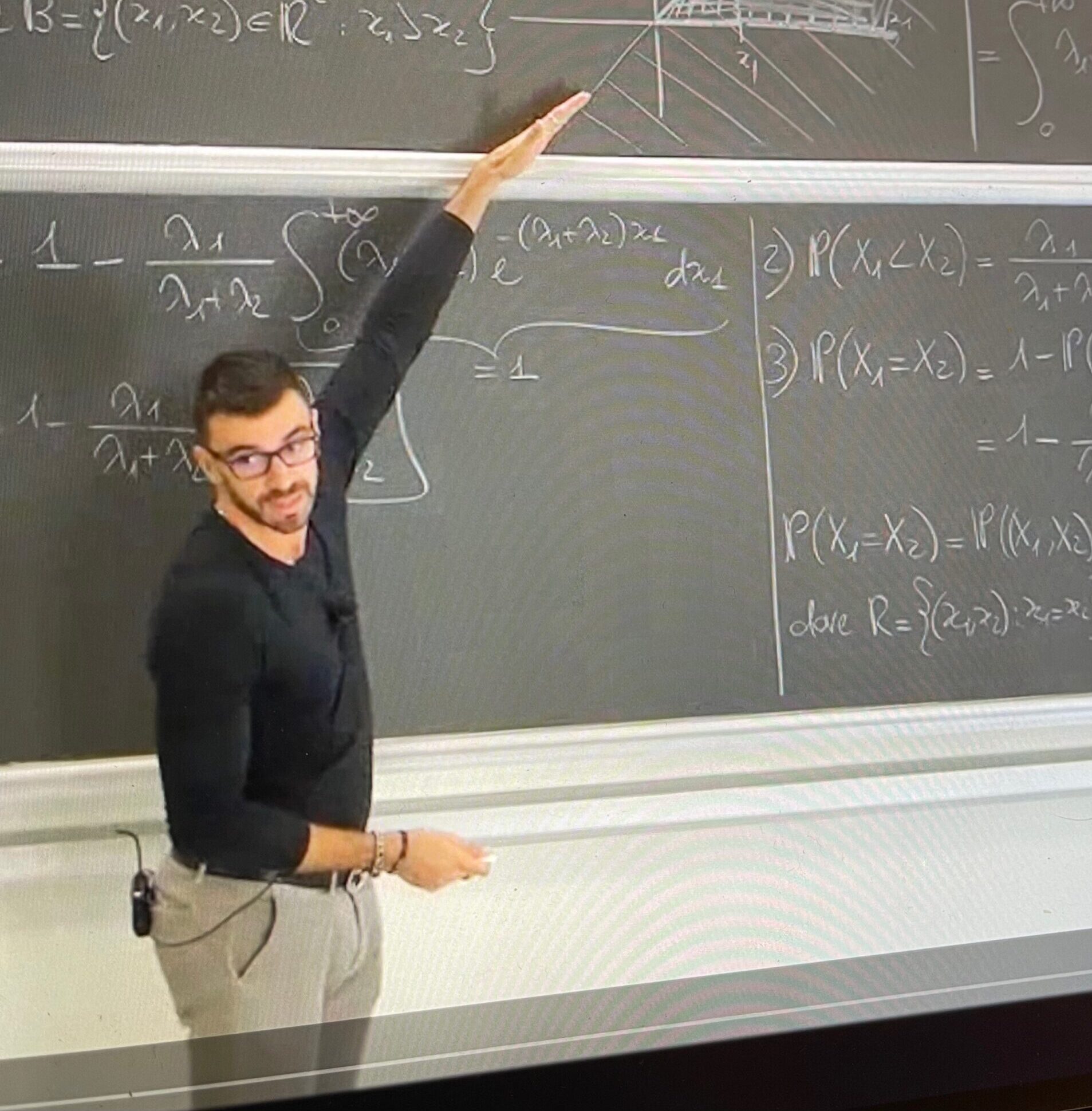
Luca Scarpa is an associate professor of Probability at the Department of Mathematics of the Politecnico di Milano. We spoke with him about his journey, his research, and his passions.
What was your academic path like?
I obtained both my bachelor’s and master’s degrees in Mathematics at the University of Pavia, the city where I was also born. I remember that from the very beginning I was passionate about probability and mathematical analysis. It was an extremely subjective preference: I found the way of reasoning and arguing in these disciplines very intuitive and natural, certainly also thanks to the rigor and passion of some of the professors I had. I chose to write a research master’s thesis on the study of certain partial differential equations for physical models.
Were you always sure about what to do after graduation?
Although I had always been attracted by the idea of an academic career, I also had many doubts about the difficulty and feasibility of such a choice. One has to take into account that the path toward a university position is very long, uncertain, and complicated. Mathematics has always been a passion of mine, but I was not (and still am not) willing to sacrifice my life outside academia for it. For example, I had no intention of moving to a remote town in the middle of nowhere just to do research in mathematics. At the end of my master’s degree, I was therefore very undecided whether to continue with a PhD or to specialize abroad in a master’s program in quantitative finance, more oriented toward the job market.
What did you decide to do in the end?
I decided to postpone the decision and pursue a PhD that would keep both paths open for the future, and that could also be valued outside academia. Before choosing the university, I chose the city—London—which would offer countless opportunities if I were to move into the world of finance. Having chosen the city, I then looked for a PhD program on a topic that both interested me and could be “marketable” in the future. After some research on UK universities, I decided to specialize in the study of stochastic partial differential equations and began my PhD at University College London.
And after the PhD?
During my PhD, I increasingly appreciated academic research, especially for the great freedom it offers, both intellectually and in terms of work. At the same time, I realized that non-academic mathematics problems studied in finance did not stimulate me at all. So I decided to try for a postdoc and was accepted at the University of Vienna, where I stayed for two and a half years and continued my research on variational methods for stochastic PDEs.
How did you end up at the Politecnico di Milano?
After almost six years abroad, I began to feel the desire to return to Italy and settle somewhere. From my experience in London, I had grown fond of big-city life, and I did not want to give that up. So Milan seemed like a great opportunity. I started applying to a few positions, and in March 2021 I began as a researcher in probability at the Politecnico di Milano, where I later became an associate professor in January 2024.
What is your research about?
Stochastic partial differential equations (SPDEs) mainly describe physical phenomena characterized by unpredictable perturbations and turbulence (for example, ripples in water when it rains, or temperature fluctuations in thermodynamics, and much more). Mathematically, one deals with stochastic evolution equations taking values in Hilbert spaces. Their study requires a strong interaction between classical probabilistic techniques and functional analytic methods, so the topic is closely aligned with what has always interested me the most.
What advice would you give to those who are currently studying?
A piece of advice for those choosing an academic or postgraduate path? Try to balance different factors: what you are passionate about, what you are good at, and what ensures a lifestyle aligned with your expectations. A sort of optimization problem, to stay on topic.
From this perspective, mathematics offers many possibilities, but it is as beautiful as it is difficult—there’s no point denying it. Studying mathematics properly requires a lot of effort, and unfortunately (or fortunately) there are no shortcuts to make the journey easier: for this reason, choosing a field you are truly passionate about is essential.