Evolution Equations and Dynamical Systems

a tribute to Vittorino Pata
on the occasion of his 60th birthday


November 27,  2026
Dipartimento di Matematica, Politecnico di Milano, Italy

Paola Antonietti

(Politecnico di Milano)

Michele Coti Zelati

(Imperial College)

Francesco Di Plinio

(Università degli Studi di Napoli Federico II)

Alberto Farina

(Université de Picardie J. Verne)

Filippo Gazzola

(Politecnico di Milano)

Claudio Giorgi

(Università degli Studi di Brescia)

Olivier Goubet

(Université de Lille)

Alain Miranville

(Université Le Havre Normandie)
09:30Opening
09:45 – 10:30Filippo Gazzola (Politecnico di Milano)Blow-up and uniqueness of Leray-Hopf solutions to forced Navier-Stokes equations
11:15 – 11:45
Coffee Break
11:45 – 12:30Francesco Di Plinio (Università degli Studi di Napoli Federico II) Weighted Sobolev regularity of singular integral operators on domains and applications
12:30 – 13:15Paola Antonietti (Politecnico di Milano) A Mathematical Perspective on Neurodegeneration
13:15 – 14:45
Lunch break
14:45 – 15:30Alberto Farina (Université de Picardie J. Verne)A double rigidity result for the Liouville equation on Riemannian surfaces
15:30 – 16:15Michele Coti Zelati (Imperial College) The fast dynamo conjecture
16:15 – 16:45
Coffee Break
16:45 – 17:30Alain Miranville (Université Le Havre Normandie)Some generalizations of the Cahn-Hilliard equation
17:30 – 18:15Claudio Giorgi (Università degli Studi di Brescia)On the role of entropy flux and entropy production in the modeling of hysteretic phase transitions

ABSTRACTS

Paola Antonietti

A Mathematical Perspective on Neurodegeneration

Abstract:
Neurodegenerative diseases are characterised by progressive neuronal dysfunction and loss, leading to cognitive and motor impairment. Despite major advances in neuroscience, the mechanisms governing disease onset, progression, and patient-to-patient variability remain only partially understood. In this talk, I will present a mathematical perspective discussing how mathematical modelling, scientific computing, and computational learning can help to better understand the dynamics of neurodegeneration. The proposed mathematical models integrate mechanistic descriptions of disease dynamics with advanced computational methods and clinical data across multiple spatial and temporal scales. In the second part of the lecture, I will discuss how computational learning approaches can be combined with physics-based modelling to predict individual trajectories from sparse, irregularly sampled, and multimodal clinical data. The lecture will highlight how mathematics can contribute to a better understanding of neurodegenerative diseases and support personalised care.

Michele Coti Zelati

The fast dynamo conjecture

Abstract:
The fast dynamo conjecture, posed by Zeldovich and Sakharov and later recorded in Arnold’s book of problems, asks whether a smooth, autonomous, divergence-free flow on the three-torus can amplify magnetic fields exponentially at a rate bounded uniformly away from zero as the magnetic resistivity vanishes. In this talk, we resolve the conjecture by constructing a flow based on the classical stretch–fold–shear (SFS) mechanism. The proof uses anisotropic Banach spaces adapted to the ideal dynamics to obtain an isolated unstable eigenmode with a distributional eigenfunction. A singular spectral perturbation argument then shows that this instability persists for small positive resistivity. The construction is robust and yields an open set of smooth autonomous fast dynamos.

Francesco Di Plinio

Weighted Sobolev regularity of singular integral operators on domains and applications

Abstract:
Calderón–Zygmund operators on rough Euclidean domains possess intrinsic difficulties absent from the whole-space setting. Among these, the associated operators exhibit genuinely noncancellative boundary contributions reflecting the geometry and irregularity of the boundary.
Our wavelet-resolution approach splits the operator into an almost-diagonal wavelet part and a family of cancellative and noncancellative paraproducts. The latter are handled through a Poincaré-type identity and sparse domination, leading to testing conditions expressed in terms of Triebel–Lizorkin and tree Carleson norms. Our final result is a sharp characterization of weighted Sobolev boundedness, replacing classical cancellation assumptions by substantially weaker testing conditions.
A particularly important application is to the Beltrami equation, where we extend the Astala–Iwaniec–Saksman strategy to higher Sobolev regularity, bypassing the qualitative compactness and commutator methods traditionally used to obtain higher regularity on domains. This yields quantitative estimates for the Beltrami resolvent and Caccioppoli estimates for quasiregular mappings, as well as quantitative Sobolev regularity on sufficiently regular domains.
Finally, I will describe how the resulting planar Beltrami elliptic estimates enter the analysis of the Coleman–Gurtin heat equation with rough anisotropic conductivity and memory. Partly joint work with A.W. Green and B.D. Wick.

Alberto Farina

A double rigidity result for the Liouville equation on Riemannian surfaces

Abstract:
We study the Liouville equation  $-∆u = e^u$   on a complete, connected, non-compact, boundaryless Riemannian surface $(M,g)$ with non-negative Ricci curvature. Assuming only some asymptotic lower bound on the solution, we establish optimal classification results for both the solutions and the ambient manifold. Our results reveal a close connection between the volume growth of the manifold and the classification of both the solutions and the underlying manifold.
This is a joint work with Giulio Ciraolo and Michele Gatti.

Filippo Gazzola

Blow-up and uniqueness of Leray-Hopf solutions to forced Navier-Stokes equations

Abstract:
We prove the existence of forces and smooth initial data for which the associated Leray-Hopf solution to the three-dimensional Navier-Stokes equations is unique and global in time, satisfies the energy equality, and exhibits infinitely many (countably many) blow-up instants within a finite time interval. We consider several classes of forces and different blow-up strengths, all of which are shown to be sharp with respect to known boundedness results in the literature. Our method also yields examples of blow-up solutions for the forced three-dimensional Euler equations. This is joint work with Paolo Galdi.

Claudio Giorgi

On the role of entropy flux and entropy production in the modeling of hysteretic phase transitions

Abstract:
The innovative approach is based on a general form of the Clausius-Duhem inequality (really, an equality) where the entropy flux and the entropy production rate are given by constitutive functions. Thermodynamic restrictions and a suitable splitting of the entropy and material constitutive functions transform the Clausius-Duhem inequality into an evolutionary partial differential equation. In particular, we develop a thermodynamically-consistent model of pseudo-elasticity in a shape memory alloy under a tensile stress. The evolution properties are described by using the temperature, the martensite fraction, and the stress as independent variables. As a result, both temperature-induced and stress-induced phase transitions and their related hysteretic loops are carefully modeled by properly choosing the free energy, "dynamic functions", and the entropy production rate. Next, to also take into account spatial diffusion, a generalization is given by letting the constitutive function depend on appropriate gradients within a Lagrangian and an Eulerian formulation. Both formulations are allowed by the occurrence of the extra-entropy flux that turns out to be proportional to the pertinent rates of temperature, stress, and mass fraction.

Olivier Goubet

Global Attractor for weakly damped nonlinear parametric Klein-Gordon Schrödinger systems

Abstract:
We consider a damped forced nonlinear Klein-Gordon Schrödinger (KGS) system known as the parametric KGS system with Yukawa coupling.
We prove the existence of a global attractor in dimension $1$ and $2$ for this system. We point out that this system is not a dissipative perturbation of a Hamiltonian system and involves an equation that acts as a nonlinear infinite memory term for the dynamics.
We also prove that this global attractor is regular and has finite fractal dimension.
These results are joint work with Marilena Poulou (West Attica, Greece)

Alain Miranville

Some generalizations of the Cahn-Hilliard equation

Abstract:
Our aim in this talk is to discuss several variants of the Cahn-Hilliard equation proposed to describe phase separation processes in binary alloys. These models are based on mechanical considerations (e.g., microforces or microconcentrations).
We focus here on the so-called strict separation property when considering the thermodynamically relevant logarithmic potentials.

Deadline: 20-11-2026


Would you like to attend the social dinner that will be held on November 27th ?*
Please note: the cost of the social dinner is not covered by the organization and will be at participants' own expense.
   
TYPE THE TEXT YOU SEE IN THE IMAGE*
(Respect uppercase and lowercase letters)
CAPTCHA code
PRIVACY DISCLAIMER*
I declare to have viewed and read the privacy disclaimer here
Purpose of processing 1.
(to participate at the event this consent is mandatory)


I declare to have viewed and read the privacy disclaimer here
Purpose of processing 2.


I declare to have viewed and read the privacy disclaimer here
Purpose of processing 3.


*Denotes required fields

If you encounter any issues while submitting the form, please reach out to helpdesk-dmat@polimi.it for assistance.


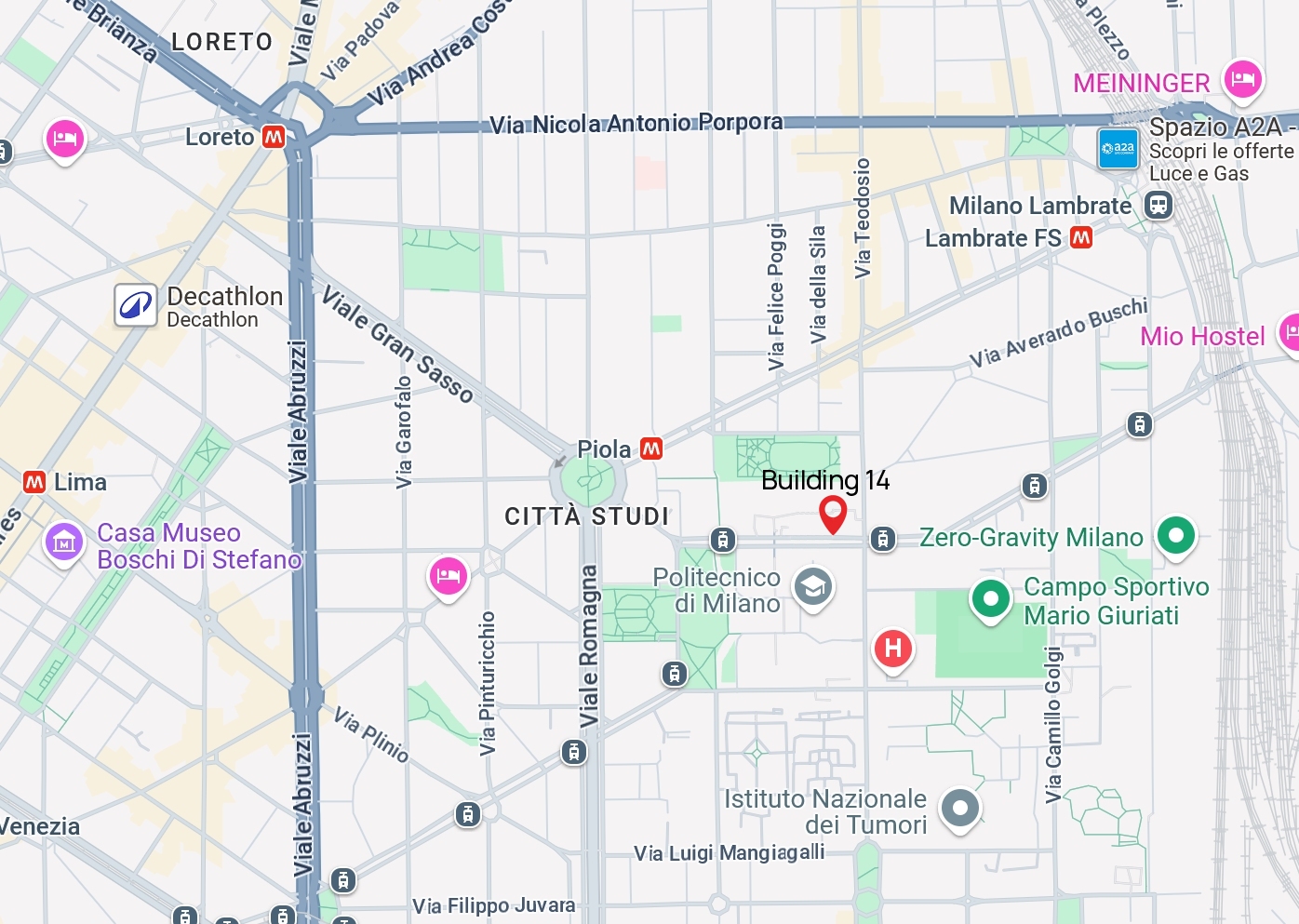
The workshop will take place at:


Aula Consiglio - 7th floor, Building 14, 
Politecnico di Milano, Via Bonardi 9, 20133 Milano (Italy)


Monica Conti, Filippo Dell'Oro, Andrea Giorgini, Maurizio Grasselli