Thursday
November 19th
14:25
Opening
14:30 – 15:20
J. Mawhin
15:25 – 16:15
L. Malaguti
16:15 – 16:40
Coffee Break
16:40 – 17:30
F. Zanolin
17:30 – 18:00
Round table
19:50
Social dinner
November 19-20, 2026
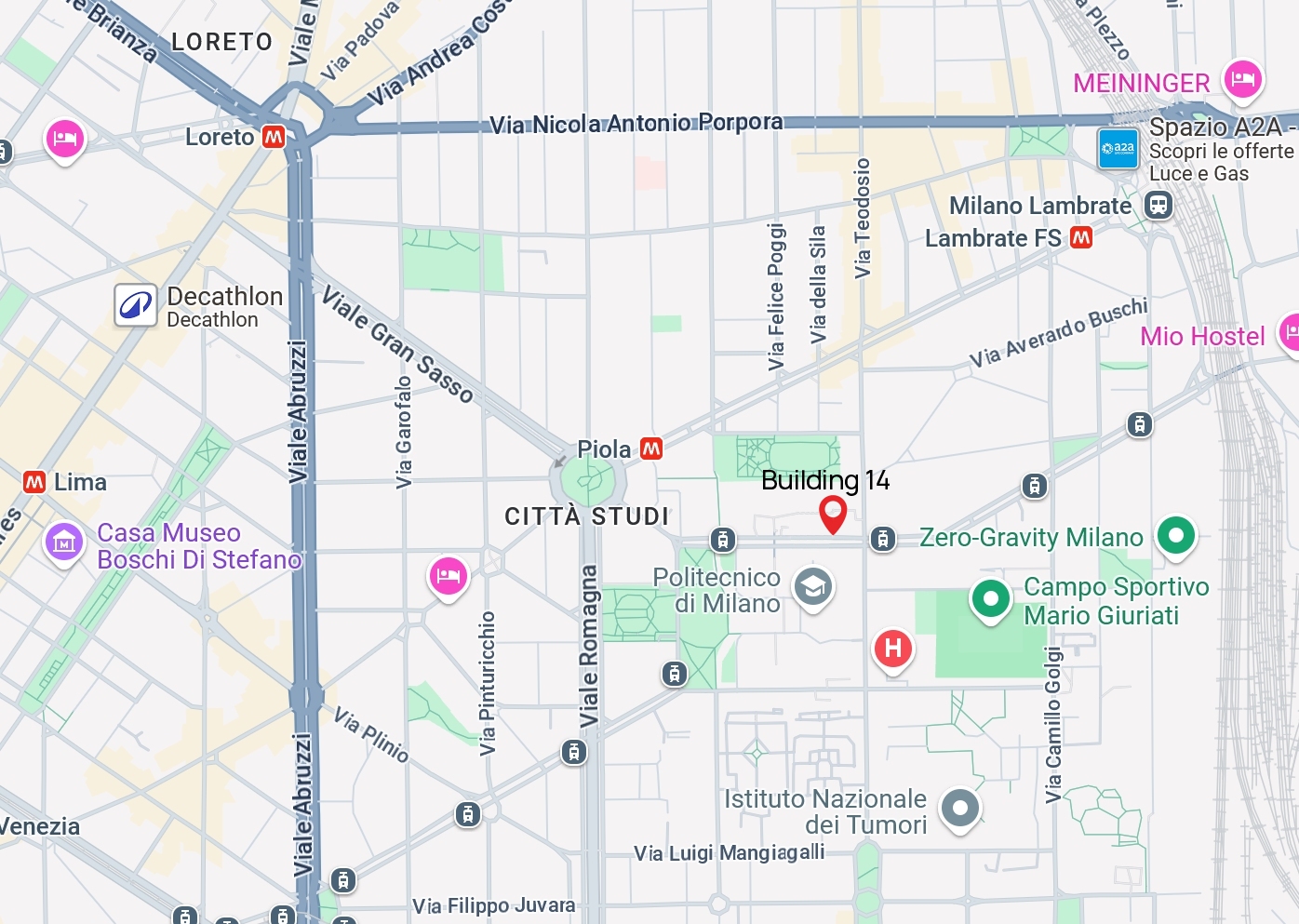
Department of Mathematics, Politecnico di Milano
University of West Bohemia, Pilsen
University of Modena and Reggio Emilia
Catholic University of Louvain
University of Granada
Rey Juan Carlos University, Madrid
University of Udine
We introduce a new reaction-diffusion model governed by a (q,r)-relativistic type diffusion, extending the p-relativistic case and encompassing both singular and degenerate diffusivity. For monostable reactions, we establish existence of decreasing traveling fronts, exploiting the study of an equivalent first-order ODE with homogeneous Dirichlet boundary conditions. We then analyze asymptotic properties of the fronts by means of comparison principles. Joint work with Maurizio Garrione and Michaela Zahradníková.
The talk focuses on some recent advances in the study of wavefront solutions in reaction–diffusion dynamics.
In the first part, we consider a reaction–diffusion equation in one spatial dimension, whose diffusion coefficient changes sign from positive to negative and then back to positive. The reaction term is bistable, with its intermediate zero lying in the region of negative diffusivity. The equation does not admit continuous wavefronts connecting the steady states 0 and 1. However, we establish the existence of a family of shock wavefronts, whose profiles exhibit a jump discontinuity, and investigate their properties and propagation speeds. We then apply these results to a recently proposed model describing the movement of a population consisting of both isolated and grouped individuals.
In the second part, we consider a system of two coupled reaction–diffusion equations describing the spatiotemporal dynamics of bacterial colonies and nutrients on agar plates. Although numerical evidence for the existence of wavefronts has long been available, their existence had not previously been established analytically. We prove the existence of an infinite family of wavefronts parameterized by their propagation speed, which ranges over a closed positive half-line. Our approach combines several analytical tools, including the shooting method and fixed-point theory in Fréchet spaces to establish existence, and the center manifold theorem to prove uniqueness. Finally, we apply similar techniques to the investigation of an epidemic model.
The results are based on joint work with Diego Berti (University of Turin), Andrea Corli (University of Ferrara), Carlota Rebelo (University of Lisbon), and Elisa Sovrano (University of Modena and Reggio Emilia).
The lecture is devoted to the tortuous history of some existence and uniqueness results for nonlinear differential or integral equations and systems, and for related operator equations generalizing the nonresonance situation in the linear situation. The title is not the unique element of the talk related to Alessandro Fonda.
Given an area-contracting dissipative homeomorphism of the plane it is shown that the coexistence of periodic points with different periods implies some complexity in the topology of the attractor. In particular, the existence of infinitely many periods implies that the attractor is a continuum with an infinite number of path components. The results are applicable to the periodic Duffing equation. This is joint work with Grzegorz Graff and Alfonso Ruiz-Herrera.
In this presentation, conceived as a symphony in three movements, I will provide a coherent overview of key concepts related to uncertainty and unpredictability in nonlinear dynamical systems. The first movement introduces the topological foundations of unpredictability, ranging from indecomposable continua to the emergence of Wada basins. In the second movement, I will focus on a specific physical example, exploring the Wada basin structure of the Hénon–Heiles Hamiltonian system and its implications for chaotic scattering and final-state sensitivity. The third and final movement introduces basin entropy as a quantitative measure of unpredictability. I will also discuss recent advances in the use of basin entropy for the classification of basins of attraction and the systematic detection and analysis of bifurcations in dynamical systems.
[1] J. Aguirre, R.L. Viana, and M. A. F. Sanjuán: Fractal structures in nonlinear dynamics. Reviews of Modern Physics 81, 333-386 (2009).
[2] A. Daza, A. Wagemakers, B. Georgeot, D. Guéry-Odelin, and M. A. F. Sanjuán: Basin entropy: a new tool to analyze uncertainty in dynamical systems. Scientific Reports 6, 31416 (2016).
[3] A. Daza, A. Wagemakers, and M. A. F. Sanjuán: Unpredictability and basin entropy. Europhysics Letters 141, 43001 (2023).
[4] A. Daza, A. Wagemakers, and M. A. F. Sanjuán: Classifying basins of attraction using the basin entropy. Chaos Solit. Fractals 159, 112112 (2022).
[5] A. Wagemakers, A. Daza, and M. A. F. Sanjuán: Using the basin entropy to explore bifurcations. Chaos Solit. Fractals 175, 113963 (2023).
[6] A. Daza, A. Wagemakers, and M. A. F. Sanjuán: Multistability and unpredictability. Physics Today 77 (11), 44-50 (2024).
My collaboration with Alessandro Fonda has spanned more than 25 years, encompassing 9 joint publications and various discussions that have led to further results.
In the first part of my talk, I would like to present some key findings from Alessandro’s work (some of which also emerged from our collaborations) along with some major, more recent, developments.
In the second part, I will discuss some recent results concerning boundary value problems for differential equations in cases where the local Lipschitz condition is not satisfied.
In an indirect way, these are also linked to some significant achievements within Alessandro’s body of work.
[1] A. Fonda, F. Zanolin: Periodic solutions to second order differential equations of Liénard type with jumping nonlinearities. Comment. Math. Univ. Carolin. 28, 33-41 (1987).
[2] A. Fonda, M. Sabatini, F. Zanolin: Periodic solutions of perturbed Hamiltonian systems in the plane by the use of the Poincaré-Birkhoff theorem. Topol. Methods Nonlinear Anal. 40, 29-52 (2012).
[3] A. Fonda: Uniformly persistent semidynamical systems. Proc. Amer. Math. Soc. 104, 111-116 (1988).
[4] L. Burra, F. Zanolin: Analysis of the period map for a singular ODE related to the Liebau phenomenon. J. Math. Anal. Appl. 537, 128317 (2024).
[5] J. López-Gómez, P.H. Rabinowitz, F. Zanolin: Non–negative solutions of a sublinear elliptic problem. J. Fixed Point Theory Appl. 26, 32 (2024).